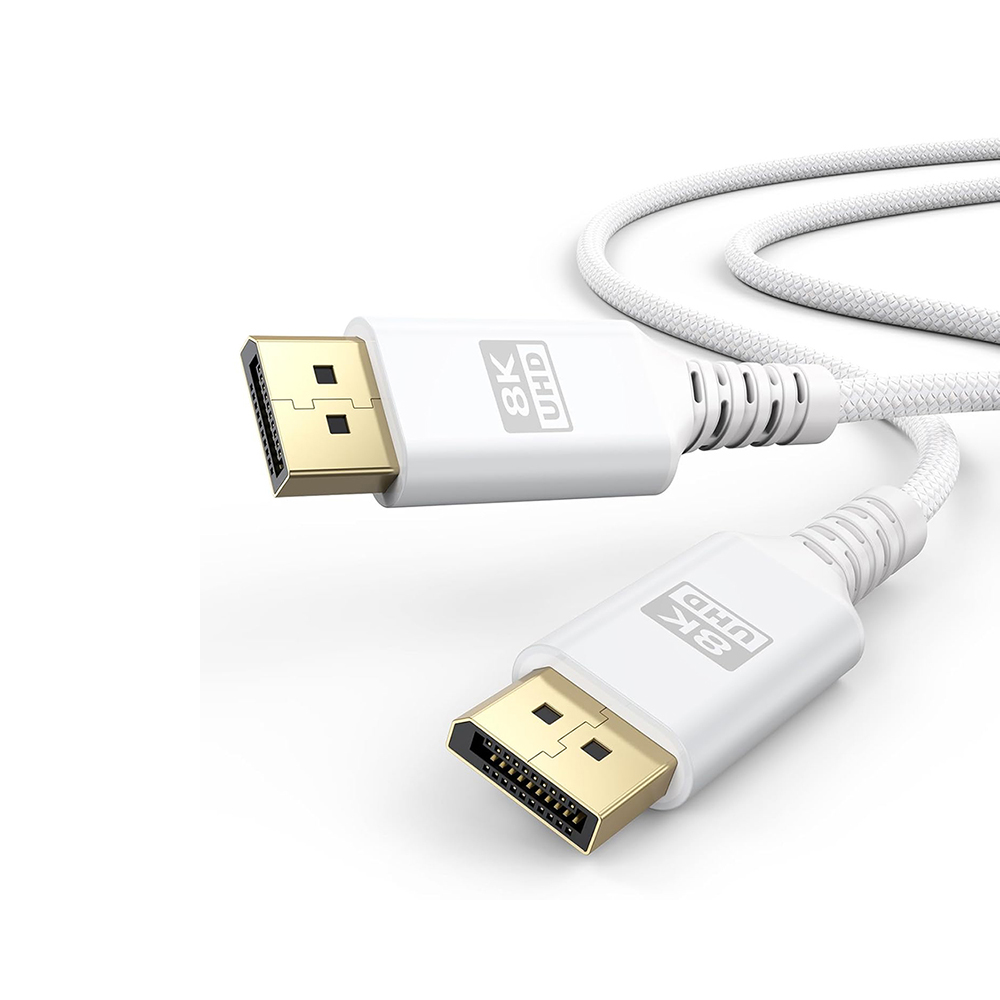
Category Differentiation: Four Dimensions Defining the DP Cable Family:
Based on technical characteristics, functional requirements, and application scenarios, DP cables have been clearly categorized into distinct types, each emphasizing different aspects such as transmission distance, compatibility, and cost.
1. By Version: Performance Gradient from Basic to Flagship
Different DP version cables offer distinct performance tiers and must match device support:
Entry-level (DP 1.0-1.1): 10.8Gbps bandwidth, suitable for office monitors, older laptops, and devices supporting resolutions below 2560×1600. Currently phasing out of mainstream markets;
Mid-tier (DP 1.2): 21.6Gbps bandwidth. The mainstream choice for 2K 144Hz gaming and 4K 60Hz office scenarios, offering outstanding value and compatibility with most mid-to-high-end displays.
High-End (DP 1.4): 32.4Gbps bandwidth. Utilizes Display Stream Compression (DSC) technology to enable 8K 60Hz transmission. Suited for high-end gaming monitors (4K 144Hz) and professional design displays. Currently, the market's primary shipment driver.
Flagship-grade (DP 2.0-2.1): Bandwidth 77.37-80Gbps, supports extreme scenarios like 16K 60Hz and 8K 120Hz. Compatible with next-generation graphics cards and flagship display devices, currently entering professional markets.
2. By Signal Amplification Method: Active vs. Passive Adaptation
This is a key classification affecting transmission distance and stability, with the core difference being whether a signal amplification chip is built in:
Passive DP Cables: Lack signal amplification modules, featuring a simple structure and lower cost. Suitable for short distances (within 6 feet / 1.8 meters) and low-bandwidth scenarios (below 4K 60Hz). Signal transmission relies on the device's native drive capability; exceeding the recommended distance may cause screen stuttering and color distortion.
Active DP Cables: Incorporate signal amplification chips to actively boost attenuated signals, supporting long-distance (over 1.8 meters) and high-bandwidth transmission (8K 60Hz, 4K 240Hz). Some premium models also support concurrent training with multiple repeaters, further extending transmission distances. Widely used in professional server rooms and large exhibitions, though priced at approximately 2-3 times that of passive cables.
3. By Functional Interface: Compatibility Extensions for Native DP vs. Conversion Cables
To adapt to different device interfaces, DP cables have spawned conversion products, primarily categorized into two types:
Native DP Cables: Both ends feature DP connectors (including Mini DP and Micro DP), ensuring zero signal conversion loss. These are the optimal choice for connecting devices with identical interfaces, such as a graphics card to a DP monitor.
DP Adapter Cables: Includes types like DP to HDMI and DP to USB-C. Distinguish between active and passive types. Passive cables only support 1080p at 60Hz, suitable for basic office scenarios. Active cables incorporate conversion chips, supporting 4K at 60Hz, HDR, and Dolby Atmos audio. Ideal for cross-interface scenarios like connecting game consoles to HDMI TVs or laptops to USB-C monitors.